top of page

Why do astronauts dump their partners on earth?.... They don't want to risk breaking-up in orbit! Have you ever looked up at the night sky and marveled at the vastness and beauty of space? Have you ever imagined traveling to other planets or galaxies and exploring the mysteries of the universe? If so, you are not alone. Humans have been fascinated by space for centuries, and have sent thousands of spacecraft and satellites into orbit around Earth to study, communicate, and navigate.


ree


However, our space activities have also created a growing problem that threatens the safety and sustainability of space operations: space debris. Space debris, also known as space junk or orbital debris, refers to any human-made object that orbits Earth but no longer serves a useful purpose. This can include defunct satellites, rocket stages, fragments from explosions or collisions, and even paint flecks or screws.


The Kessler Syndrome, named after the American astrophysicist Donald J. Kessler who first proposed it in 1978, is a hypothetical scenario in which the density of space debris in certain orbits becomes so high that collisions between objects create more debris, which in turn increases the collision risk and creates a chain reaction that could render the affected orbits unusable for decades or centuries. Kessler Syndrome is often compared to a cascading effect or a snowball effect, in which a small disturbance triggers a large and irreversible change.


Kessler Syndrome is not a mere science fiction plot or a distant possibility. It is a real and growing concern for space agencies, satellite operators, and astronomers. According to the European Space Agency (ESA), there are currently over 34,000 pieces of space debris larger than 10 cm in orbit around Earth, and millions of smaller fragments that are harder to track but can still cause damage to spacecraft or satellites. Some of this debris are traveling at speeds of up to 28,000 km/h, which makes them a serious threat to any object in their path.


ree

Space Debris in Low Earth Orbit


Kessler Syndrome could have several consequences for space activities and for our daily lives. If a critical orbit, such as the low Earth orbit (LEO) where most satellites and the International Space Station (ISS) reside, became too cluttered with debris, it could become impossible to launch new satellites or maintain the existing ones. This could disrupt global communication, navigation, weather forecasting, disaster monitoring, and other vital services that rely on satellites. It could also increase the risk of collisions with crewed missions or space tourism, endangering human lives and creating more debris. Much like the 2013 film Gravity where Sandra Bullock and George Clooney play American astronauts who are stranded in space after the mid-orbit destruction of their Space Shuttle, and attempt to return to Earth.


Preventing the Kessler Syndrome requires a multi-faceted approach that involves reducing the creation of new space debris, removing existing debris, and mitigating the effects of debris on space operations. Some of the measures that have been proposed or implemented include:


  • Designing satellites and rockets to be more robust and resistant to collisions or explosions, and to deorbit themselves after their mission is over.

  • Conducting controlled reentries of larger objects that pose a significant risk to populated areas, such as defunct satellites or rocket stages.

  • Using lasers, nets, or other techniques to capture and remove debris from orbit, either by dragging them down to burn up in the atmosphere or by sending them to a disposal orbit.

  • Coordinating space activities and sharing data to avoid collisions and minimize the risk of debris creation.


The Kessler Syndrome is a sobering reminder that our actions on Earth have consequences beyond our planet. It highlights the need for responsible and sustainable space exploration and use, and the importance of international cooperation and coordination to tackle global challenges. As we continue to venture into space and expand our horizons, let us also remember to protect the space environment that we share with other species and future generations.


Spring is just around the corner! In 2023, the first day of spring will be March 20th. Spring is a wonderful time of year for astronomy and stargazing, with the warmer weather and longer days providing ideal conditions for observing the night sky. Whether you're a seasoned astronomer or a beginner, there are plenty of celestial events and phenomena to look out for this season.


ree

The first day of spring is determined by the vernal equinox. The vernal equinox is the moment when the the Sun is directly over Earth's equator, resulting in equal amounts of daylight and darkness. This marks the beginning of the spring season in the Northern Hemisphere and the autumn season in the Southern Hemisphere.


There's lots to enjoy in the sky this spring from meteor showers, star clusters, galaxies, to planetary alignments, there's something for everyone to enjoy. Here are some of the highlights to look out for:


The Full Worm Moon: On March 7th, the Full Worm Moon will light up the night sky. This is the final full moon of the winter and gets its name from the earthworms that emerge from the soil as the weather starts to warm up. It's a great opportunity to observe the full Moon and take a final moon lit hike/snowshoe this winter.


ree

mile high moon over Denver/Sloans lake


Mars: The Red Planet will be visible high in the sky in the early evening hours on through midnight, setting in the west as the night progresses. Look for a reddish-orange dot that is brighter than most stars. for more information check out our post covering mars this season: https://www.astrotours.org/post/mars-returns


ree

Mars


Jupiter: This gas giant is still visible in the early evening sky, with Jupiter shining brightly in the southwest. Jupiter is best viewed through a telescope or binoculars, which can reveal the red stripes (maybe even the great spot) and the rapidly moving moons. look at Jupiter in a telescope once it's dark enough to see it then check back on it in an hour and you will be able to witness the moons moving around the planet. learn more in our post about Jupiter here: https://www.astrotours.org/post/by-jove-1


ree

Jupiter and four of its moons.


Venus: Venus will be visible in the early evening hours in the west, just after sunset. Look for Venus, low on the horizon in the west. In a telescope or small binoculars you will be able to see the phases of Venus much like the phases of the moon. you can track Venus's phases and how they change if you check back on Venus over the next few months. learn more about Venus in our blog post here: https://www.astrotours.org/post/venus-1


ree

Phases of Venus


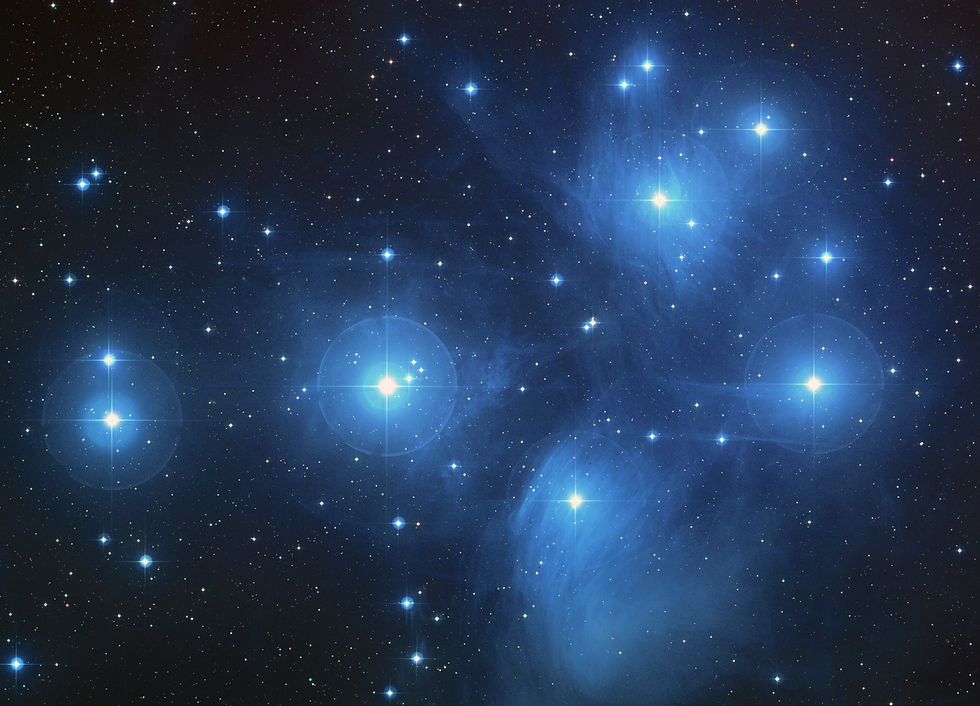
The Seven Sisters: Also known as the Pleiades, is a prominent open star cluster located in the constellation Taurus. The cluster is easily visible to the naked eye, with six or seven (depending on how good your eyes are) of the brightest stars visible in a compact group. learn more about the folklore of the seven sisters in our post here: https://www.astrotours.org/post/let-s-get-sirius-about-orion


ree

Hubble image of the 7 Sisters


The Beehive Cluster: Also known as M44, this open star cluster is located in the constellation Cancer and is visible with the naked eye in a dark sky. Find Cancer using a star chart or a phone star app and look for a fuzzy patch of light containing dozens of stars.


ree

M44 in a telescope


The Orion Nebula: This bright, colorful cloud of gas and dust is located in the constellation Orion and can be seen with the naked eye in a dark sky. It is best viewed through binoculars or a telescope, which can reveal its intricate structure and the stars forming within it.


ree

How to find the Orion Nebula


The Lyrid meteor shower: This annual meteor shower peaks around April 22nd and is known for its bright, fast-moving shooting stars. The Lyrids are caused by debris from Comet C/1861 G1 Thatcher, which burns up in Earth's atmosphere. We have a program on April the 22nd to observe this shower if you would like to book it visit: AstroTours.org/book


To get the most out of your stargazing experience, make sure to find a dark location away from city lights, and give your eyes time to adjust to the darkness. It's also a good idea to bring along a red flashlight to help you navigate and read star charts without disrupting your night vision.


Spring is an exciting time for astronomy and stargazing, with plenty of opportunities to explore the wonders of the night sky. So grab your telescope or binoculars, find a comfortable spot, and enjoy the show or enjoy the show with us on one of our events book now at AstroTours.org/book


ree


With all of the balloons and UFOs flying around and falling out of the sky these days I thought I'd take the time to get to the bottom of one of America's best known UFO mysteries. In 1947, the small town of Roswell, New Mexico, became the center of a major controversy that would spark decades of speculation and conspiracy theories. The incident was initially reported as a crash of an unidentified flying object (UFO) that was recovered by the US military. However, over time, it was revealed that the object was actually a top-secret government project known as Project Mogul.


ree

Project Mogul was a joint effort between the US military and the newly formed Central Intelligence Agency (CIA) to develop a high-altitude surveillance balloon that could detect sound waves from Soviet nuclear weapons tests. The project used balloons that carried listening devices and traveled in the upper atmosphere. The balloons were made of lightweight materials, such as neoprene, and were designed to be undetectable to radar.


ree

Major Jesse A. Marcel holding foil debris from Roswell, New Mexico, UFO incident, 07/08/1947


On June 14, 1947, one of these balloons crashed on a ranch near Roswell, New Mexico. The debris was found by a local rancher, Mac Brazel, who reported it to the local sheriff. The military arrived on the scene soon after the call to the sheriff and retrieved the debris. The military stated to the public that they had recovered a "flying disc," sparking speculation and rumors about extraterrestrial life and a government cover-up. The incident gained lots of attention and became known as the Roswell UFO incident. To this day the Roswell UFO incident is still a popular subject for conspiracy theories and in pop culture.


ree

Newspaper clipping from Roswell Daily Record on July 9, 1947 covering the Roswell UFO incident.


Over the years, the government has declassified documents related to Project Mogul and the Roswell incident, shedding light on what really happened. In 1994, the US Air Force released a report that concluded that the Roswell incident was a result of a Project Mogul balloon falling out of the sky and the military covering their tracks so the capabilities and intel gathered by Project Mogul would not be known by the Soviets.


Despite the government's attempts to clarify the situation, many people still believe in the conspiracy theories surrounding the incident. Some argue that the government is covering up the existence of extraterrestrial life or extraterrestrial technologies they gained from the crashed UFO. Others believe that the government intentionally misled the public to test the waters for a potential UFO threat. A even less common theory is that the Roswell incident involved time travel, rather than extraterrestrial life. That the military recovered a time machine or some other form of time travel technology, which they have kept hidden from the public (this is a personal favorite as there's a Futurama episode that plays with this idea).


ree

The UFO has helped the small town grow with an influx of tourism this is taken from a display at Roswell's "UFO Museum"


While the incident may remain a topic of debate and speculation, the evidence suggests that it was a case of misidentification rather than an encounter with extraterrestrial life. I would guess the same is true for the UFOs that are currently being shot down but I'm still excited to see the evidence as it comes out.


bottom of page