
.png)
Venus
An Earth-sized world whose thick atmosphere traps extraordinary heat.
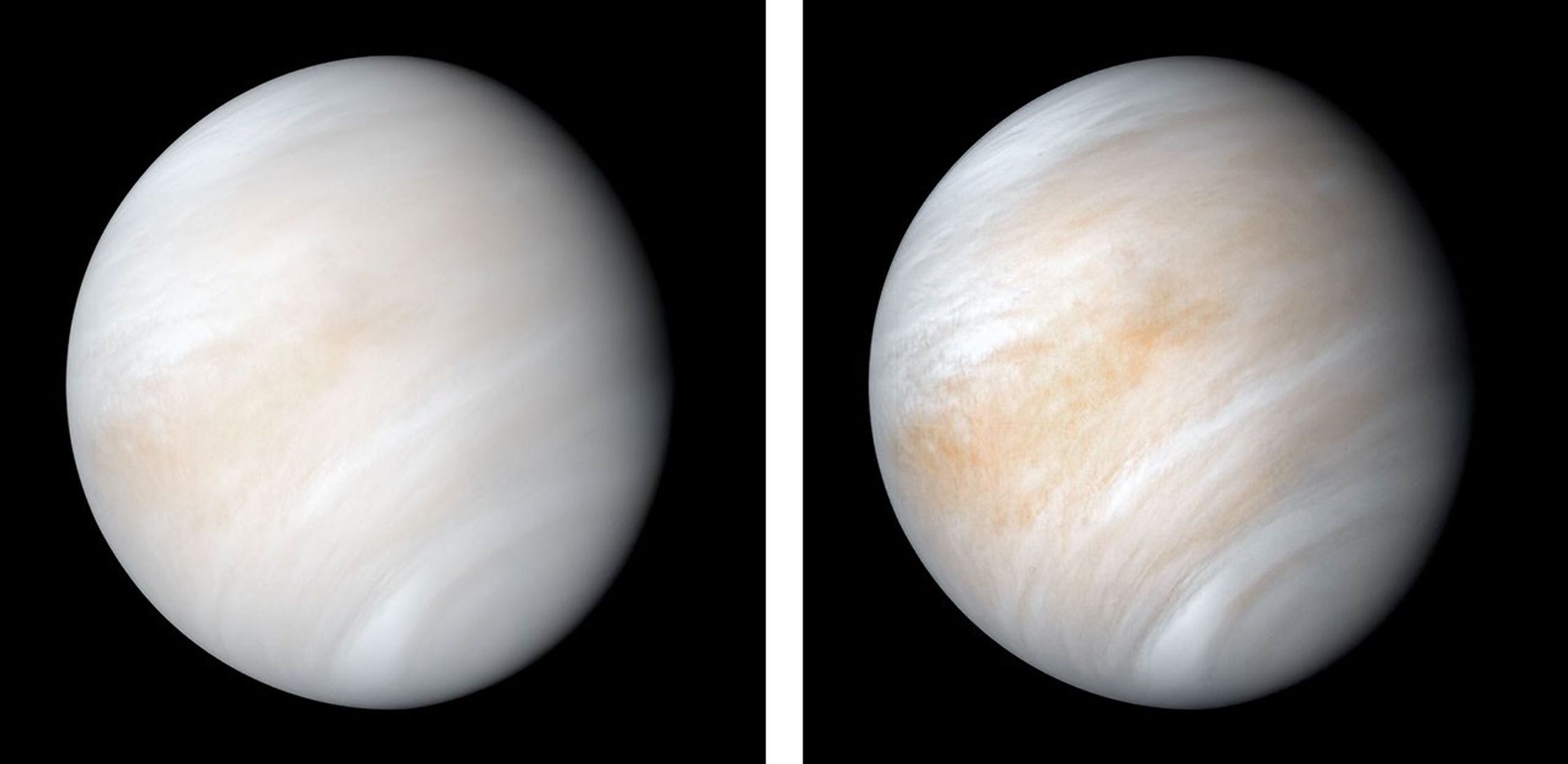
Quick facts
Object type: Terrestrial planet
Average distance from Sun: 0.723 AU; 108,200,000 km; 67,232,363 miles
Distance note: Average orbital distance (semimajor axis), not the planet’s changing distance from Earth.
Diameter: 12,104 km; 7,521 miles
Diameter note: Equatorial diameter; approximate and rounded.
Known moons: 0
Moon count last verified: 2026-10-03
About this count: Known natural satellites; counts change when discoveries are confirmed.
Year: 224.7 Earth days
Rotation: About 243 Earth days, retrograde
Solar day: About 116.75 Earth days
Surface gravity: 8.9 m/s²
Gravity note: Approximate equatorial surface acceleration including rotation; values are rounded.
Temperature: Average surface temperature about 464 °C (867 °F).
Atmosphere / composition: Rocky world with a dense, mostly carbon-dioxide atmosphere and sulfuric-acid clouds.
Rings: No known rings.
Remember this
Venus takes longer to rotate once than to orbit the Sun.
Explore this world
Venus shows how strongly an atmosphere can shape a planet. Its greenhouse effect maintains intense surface heat beneath a global cloud layer. Slow retrograde rotation makes its rotation period longer than its year, while its sunrise-to-sunrise day is shorter.
What makes it distinctive
Radar penetrates the clouds to reveal volcanic plains and deformed terrain.
Exploration
Venera landers reached the surface; NASA’s Magellan mapped it using radar.
Mission updates
NASA’s DAVINCI and VERITAS are planned to investigate Venus’s atmosphere and surface. Their mission pages provide current plans.
Mission information last verified: 2026-10-03
Image credit
NASA/JPL-Caltech
View the original image and its context
Sources and further reading
NASA science and mission reference
NASA science and mission reference
NASA science and mission reference
NASA science and mission reference
Science last verified: 2026-10-03
This permanent Solar System guide accompanies reusable AstroTours Planet Walk flags. Discovery continues, so online information can change while your flag's QR address stays the same.