
.png)
Uranus
An ice giant with an extreme axial tilt and long seasons.
Quick facts
Object type: Ice giant
Average distance from Sun: 19.165 AU; 2,867,000,000 km; 1,781,471,208 miles
Distance note: Average orbital distance (semimajor axis), not the planet’s changing distance from Earth.
Diameter: 51,118 km; 31,763 miles
Diameter note: Equatorial diameter; approximate and rounded.
Known moons: 29
Moon count last verified: 2026-10-03
About this count: Known natural satellites; counts change when discoveries are confirmed.
Year: About 84 Earth years
Rotation: About 17.2 hours, retrograde
Solar day: About 17.2 hours
Gravity note: No solid surface. Surface gravity is omitted.
Temperature: About −195 °C (−319 °F) at the 1-bar atmospheric level.
Atmosphere / composition: Hydrogen, helium and methane atmosphere above an interior enriched in heavier materials.
Rings: A system of narrow, faint rings.
Remember this
Uranus’s axis is tilted about 98 degrees, so it rotates almost on its side.
Explore this world
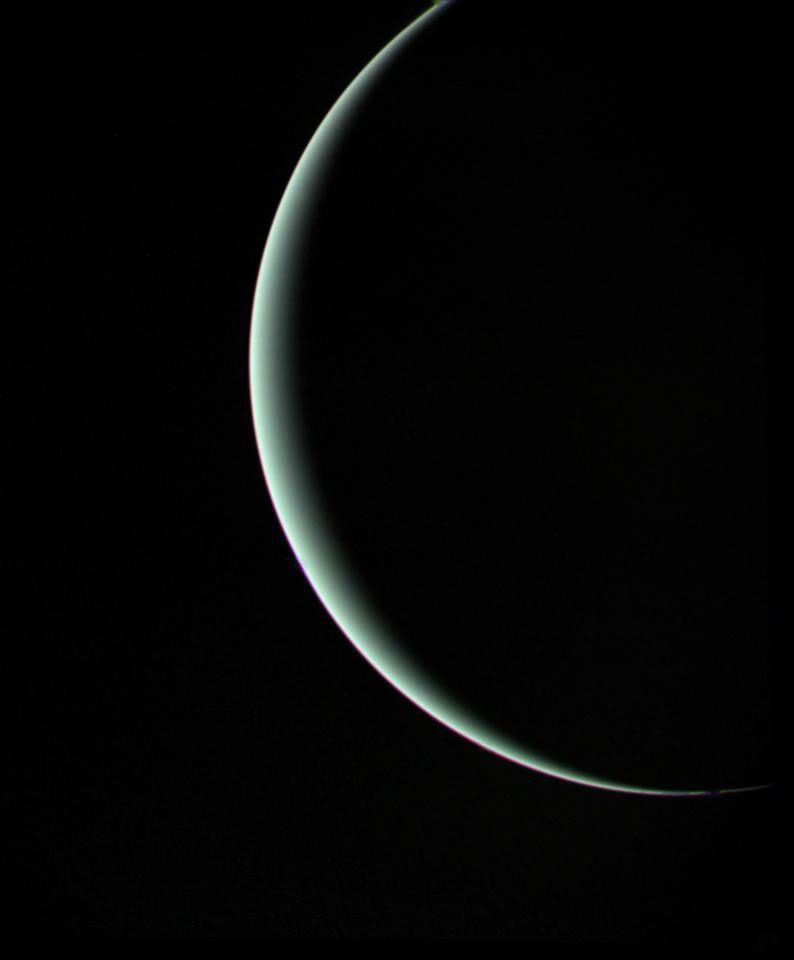
Uranus has an orientation unlike the other planets. During its long orbit, each pole experiences extended periods of sunlight and darkness. Methane in the atmosphere absorbs red light and contributes to its pale blue-green appearance.
What makes it distinctive
Faint rings and small moons surround the planet. The current recognized moon census is maintained separately from older overview-page counts.
Exploration
William Herschel identified Uranus in 1781. Voyager 2 visited in 1986.
Mission updates
Voyager 2 remains the only spacecraft to have visited Uranus up close. Telescopes continue to study this distant system.
Mission information last verified: 2026-10-03
Image credit
NASA/JPL
View the original image and its context
Sources and further reading
NASA science and mission reference
JPL recognized satellite census
NASA science and mission reference
Science last verified: 2026-10-03
This permanent Solar System guide accompanies reusable AstroTours Planet Walk flags. Discovery continues, so online information can change while your flag's QR address stays the same.