
.png)
Sun
Our nearby star powers life and holds the Solar System together.
Quick facts
Object type: Star
Average distance from Sun: 0 AU; 0 km; 0 miles
Distance note: The Sun is the zero point of this walk; Earth is about 1 AU away.
Diameter: 1,400,000 km; 869,920 miles
Diameter note: Approximate photospheric diameter, rounded to two significant figures.
Moons: Not applicable to a star; the planets orbit the Sun.
Year: Not applicable around the Sun; about 230 million years around the Milky Way.
Rotation: About 25 Earth days at the equator; about 36 near the poles.
Solar day: Varies with latitude and observer; the Sun has differential rotation.
Gravity note: No solid surface. Surface gravity is omitted.
Temperature: Photosphere about 5,500 °C (10,000 °F); core about 15 million °C (27 million °F).
Atmosphere / composition: Hydrogen and helium plasma.
Rings: Dust structures occur in the Solar System; the Sun has no planetary ring system.
Remember this
The Sun spins faster at its equator than near its poles.
Explore this world
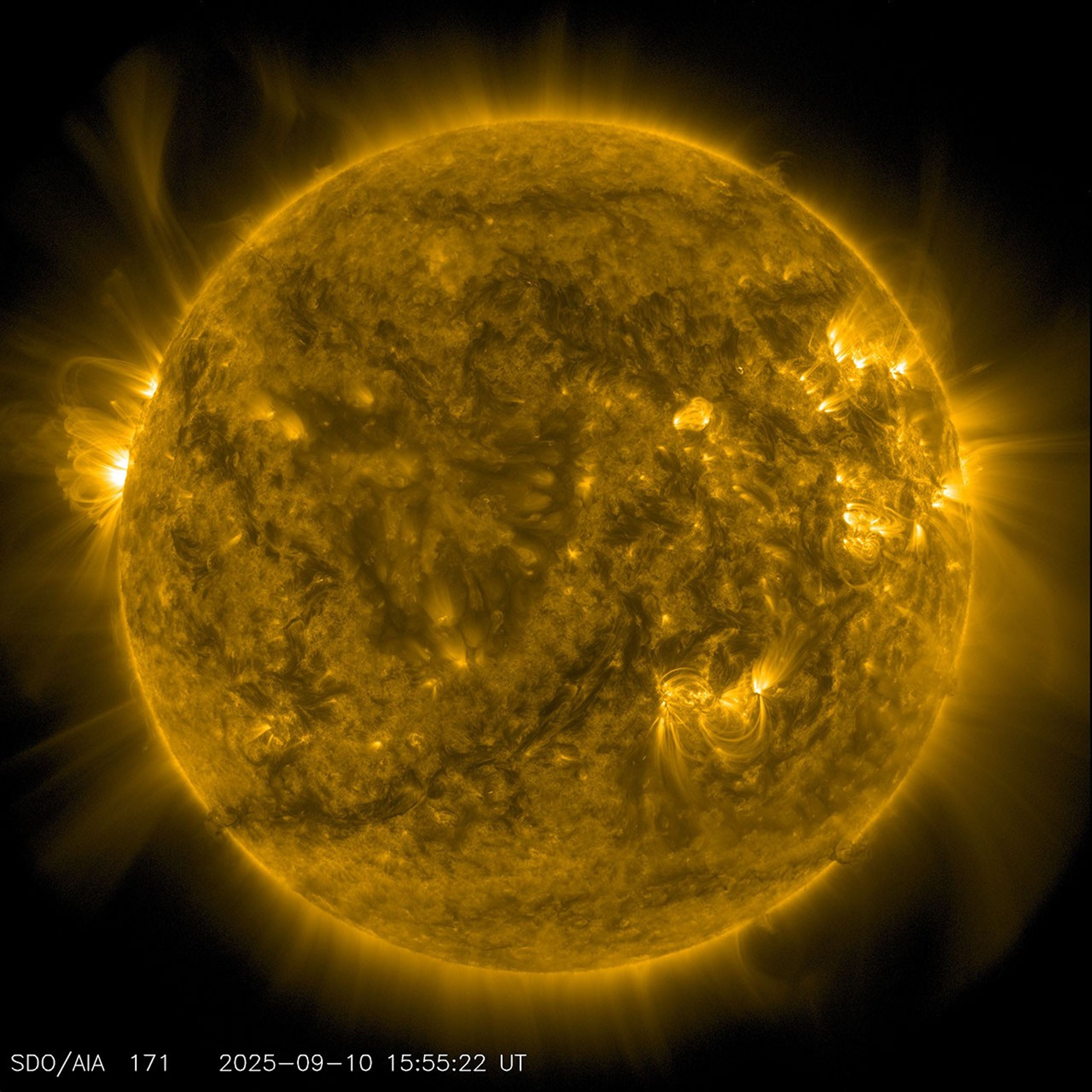
Fusion in the Sun’s core transforms hydrogen into helium and supplies the energy that eventually reaches Earth as sunlight. The visible photosphere is only one layer of this changing star. Above it, the much hotter corona extends into space.
What makes it distinctive
Sunspots, flares and eruptions reveal the Sun’s changing magnetic field. Solar material flowing outward becomes the solar wind, which can interact with Earth’s magnetic environment.
Exploration
Space observatories study the Sun at wavelengths that reveal different temperatures and layers.
Mission updates
Explore NASA’s Solar Dynamics Observatory, Parker Solar Probe and ESA/NASA Solar Orbiter for ongoing solar research.
Mission information last verified: 2026-10-03
Image credit
NASA/GSFC/Solar Dynamics Observatory
View the original image and its context
Sources and further reading
NASA science and mission reference
Science last verified: 2026-10-03
This permanent Solar System guide accompanies reusable AstroTours Planet Walk flags. Discovery continues, so online information can change while your flag's QR address stays the same.