
.png)
Saturn
A ringed giant with a growing census of small moons.
Quick facts
Object type: Gas giant
Average distance from Sun: 9.572 AU; 1,432,000,000 km; 889,803,547 miles
Distance note: Average orbital distance (semimajor axis), not the planet’s changing distance from Earth.
Diameter: 120,536 km; 74,898 miles
Diameter note: Equatorial diameter; approximate and rounded.
Known moons: 293
Moon count last verified: 2026-10-03
About this count: Known natural satellites; counts change when discoveries are confirmed.
Year: About 29.4 Earth years
Rotation: About 10.7 hours
Solar day: About 10.7 hours
Gravity note: No solid surface. Surface gravity is omitted.
Temperature: About −140 °C (−220 °F) at the 1-bar atmospheric level.
Atmosphere / composition: Mostly hydrogen and helium.
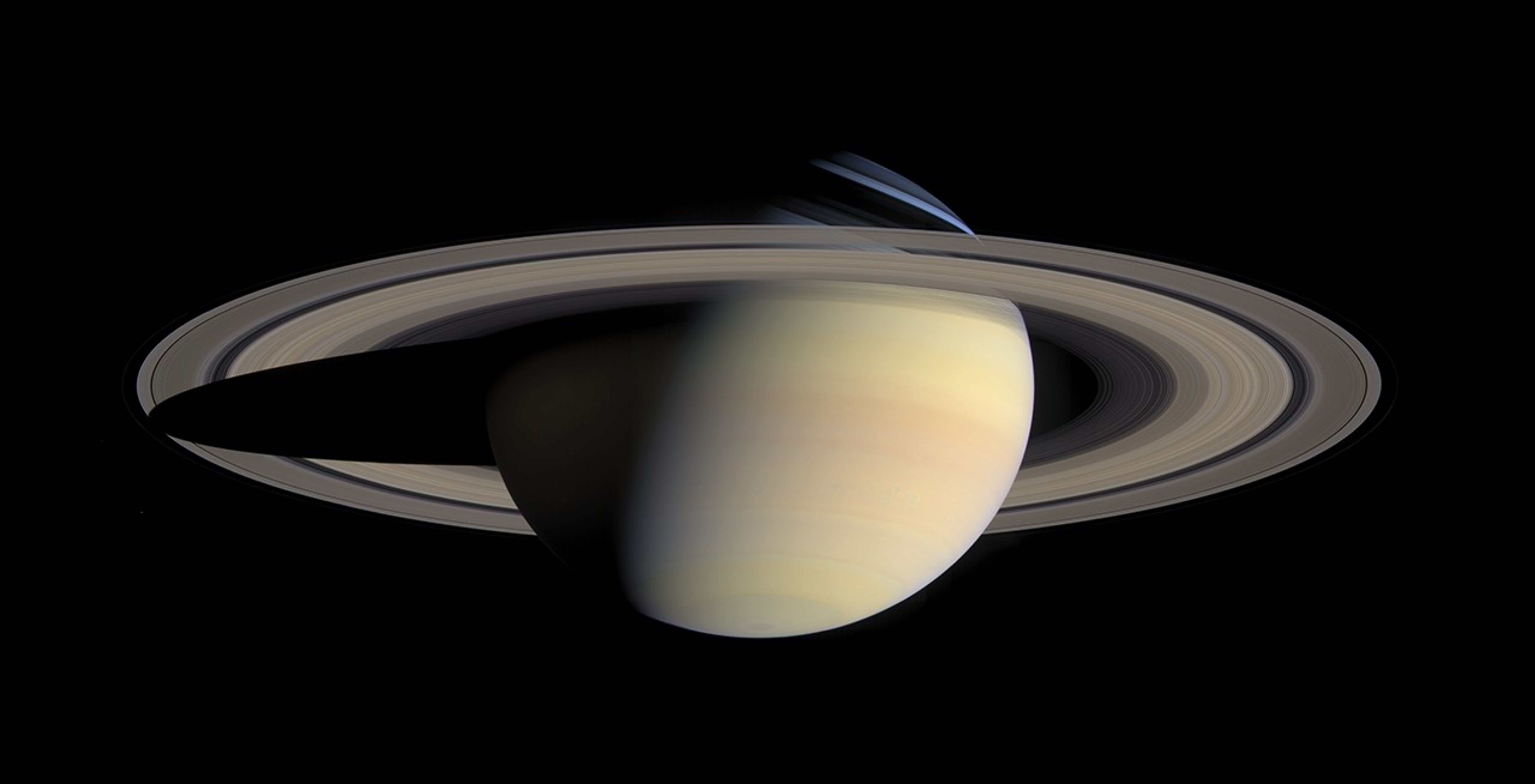
Rings: Extensive rings of separate particles, mainly water ice.
Remember this
Saturn’s rings are made of countless separate pieces orbiting the planet.
Explore this world
Saturn’s bright rings reveal orbital structure on a grand scale. Its moons offer contrasting environments: Titan has methane lakes, while Enceladus sends water-rich material into space. Small, distant satellites continue to be added to the recognized moon census.
What makes it distinctive
A dated count is a snapshot of discovery. The current count is checked against JPL’s recognized-satellite table, separately from any number printed on a flag.
Exploration
Voyager made flybys. Cassini orbited Saturn from 2004 until 2017, studying its rings, atmosphere and moons.
Mission updates
Cassini’s scientific archive remains an important source for understanding the Saturn system.
Mission information last verified: 2026-10-03
Image credit
NASA/JPL/Space Science Institute
View the original image and its context
Sources and further reading
NASA science and mission reference
JPL recognized satellite census
NASA science and mission reference
Science last verified: 2026-10-03
This permanent Solar System guide accompanies reusable AstroTours Planet Walk flags. Discovery continues, so online information can change while your flag's QR address stays the same.