
.png)
Pluto
A small Kuiper Belt world with glaciers, mountains and five moons.
Quick facts
Object type: Dwarf planet
Average distance from Sun: 39.482 AU; 5,906,400,000 km; 3,670,066,810 miles
Distance note: Average orbital distance (semimajor axis), not the planet’s changing distance from Earth.
Diameter: 2,376 km; 1,476 miles
Diameter note: Equatorial diameter; approximate and rounded.
Known moons: 5
Moon count last verified: 2026-10-03
About this count: Known natural satellites; counts change when discoveries are confirmed.
Year: About 248 Earth years
Rotation: About 153.3 hours (6.39 Earth days), retrograde
Solar day: About 153.3 hours
Surface gravity: 0.7 m/s²
Gravity note: Approximate equatorial surface acceleration including rotation; values are rounded.
Temperature: Surface temperatures are extremely cold, roughly −230 °C (−382 °F), varying by place and season.
Atmosphere / composition: Rock and ice; a thin atmosphere mainly nitrogen with methane and carbon monoxide.
Rings: No known rings.
Remember this
Charon stays over the same region of Pluto’s sky because the two worlds are mutually tidally locked.
Explore this world
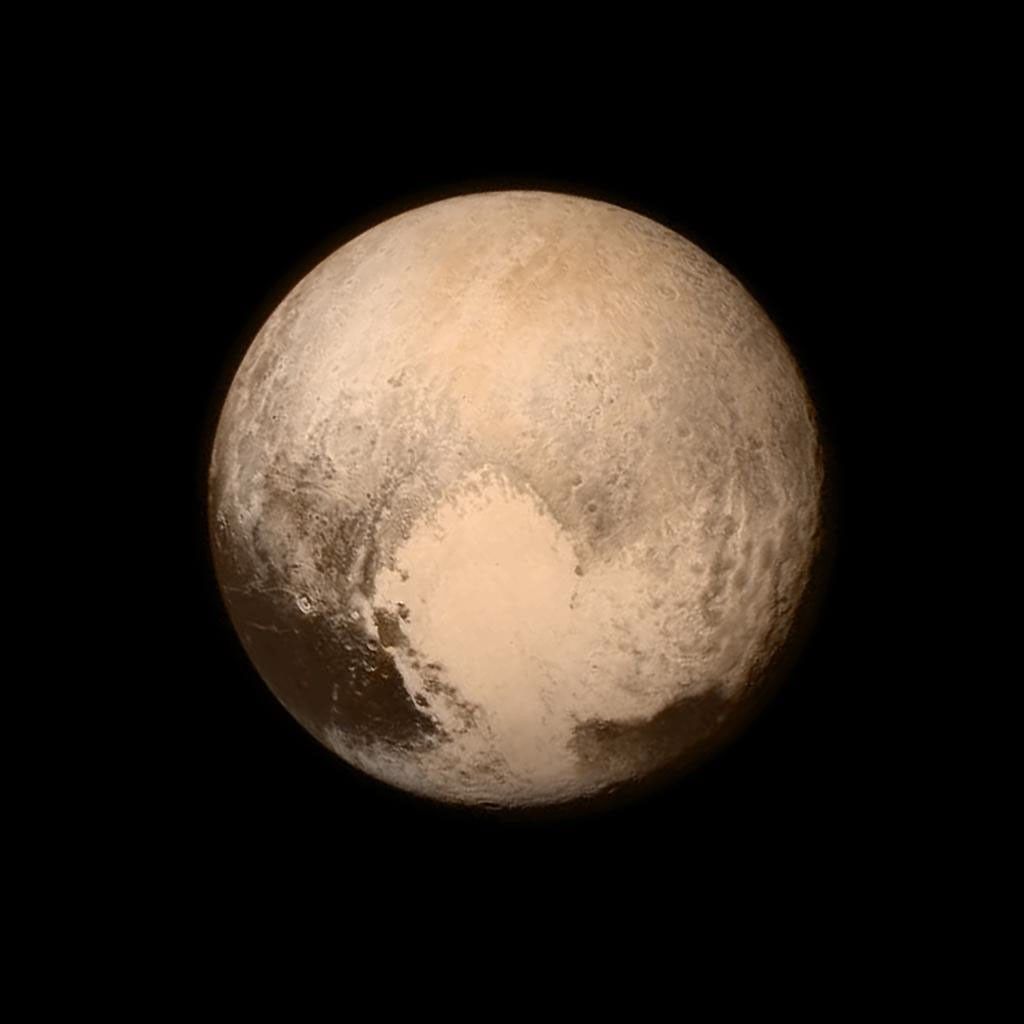
Pluto expanded our picture of small worlds when New Horizons revealed its varied terrain. Its oval orbit takes it through a large range of distances from the Sun. As a dwarf planet, Pluto is round and orbits the Sun while sharing its orbital region with other bodies.
What makes it distinctive
The bright heart-shaped terrain is one of its most recognizable features. Charon is unusually large compared with Pluto.
Exploration
New Horizons made the first close flyby of Pluto and its moons in 2015.
Mission updates
The New Horizons observations remain the only close spacecraft view of Pluto.
Mission information last verified: 2026-10-03
Image credit
NASA/Johns Hopkins University Applied Physics Laboratory/Southwest Research Institute
View the original image and its context
Sources and further reading
NASA science and mission reference
JPL recognized satellite census
Science last verified: 2026-10-03
This permanent Solar System guide accompanies reusable AstroTours Planet Walk flags. Discovery continues, so online information can change while your flag's QR address stays the same.