
.png)
Neptune
A distant, windy ice giant first located using a mathematical prediction.
Quick facts
Object type: Ice giant
Average distance from Sun: 30.181 AU; 4,515,000,000 km; 2,805,490,933 miles
Distance note: Average orbital distance (semimajor axis), not the planet’s changing distance from Earth.
Diameter: 49,528 km; 30,775 miles
Diameter note: Equatorial diameter; approximate and rounded.
Known moons: 16
Moon count last verified: 2026-10-03
About this count: Known natural satellites; counts change when discoveries are confirmed.
Year: About 165 Earth years
Rotation: About 16.1 hours
Solar day: About 16.1 hours
Gravity note: No solid surface. Surface gravity is omitted.
Temperature: About −200 °C (−328 °F) at the 1-bar atmospheric level.
Atmosphere / composition: Hydrogen, helium and methane atmosphere above an interior enriched in heavier materials.
Rings: Faint rings, including uneven concentrations called arcs.
Remember this
Neptune needed 165 years to complete its first orbit after its 1846 discovery.
Explore this world
Neptune’s motion helped confirm that gravity can reveal an unseen planet. Astronomers predicted where it should be from disturbances in Uranus’s orbit. Its atmosphere supports fast winds and changing cloud patterns despite weak sunlight.
What makes it distinctive
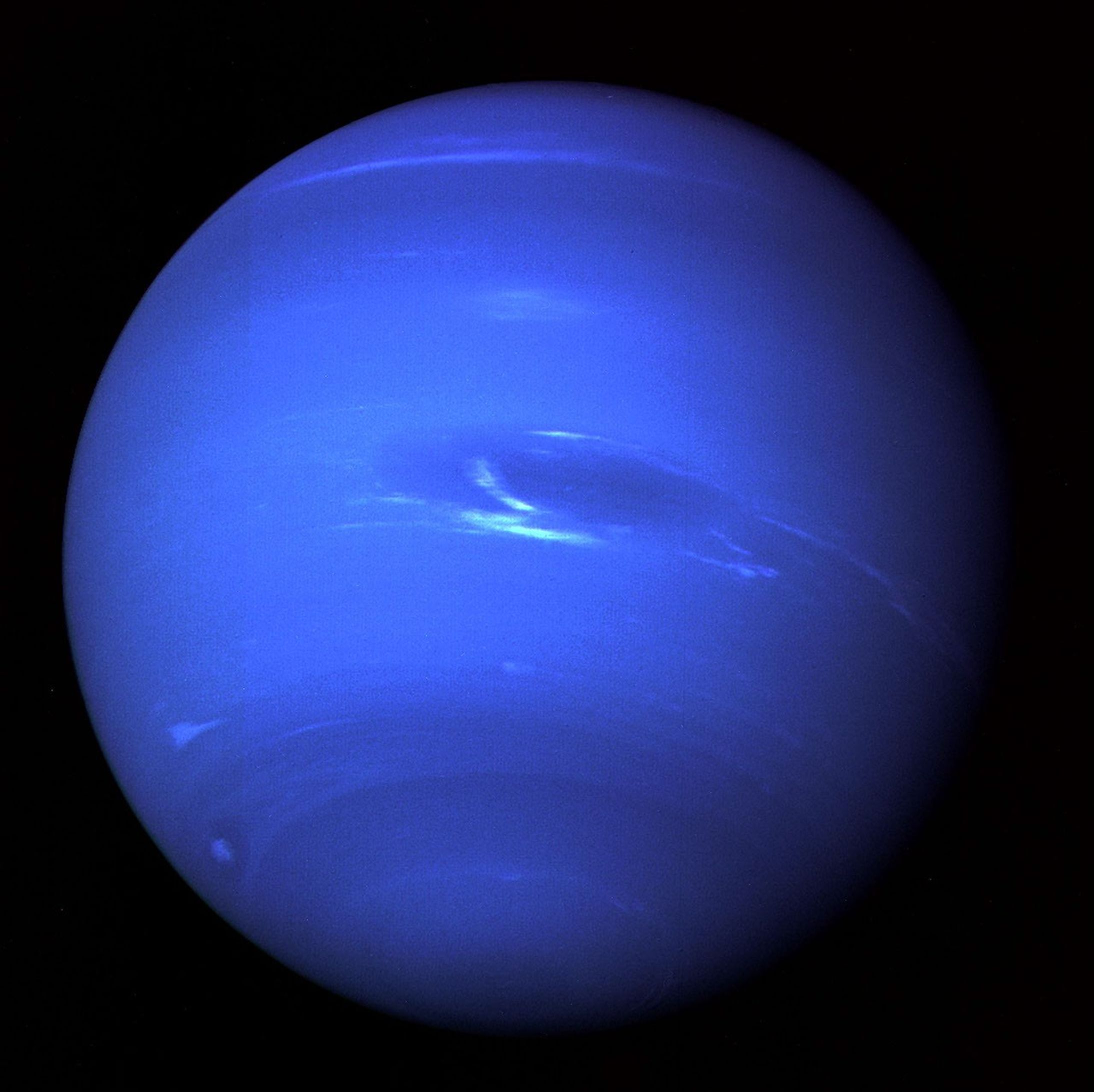
Triton, its largest moon, travels in the opposite direction to Neptune’s rotation. The archival Voyager image records atmospheric features from 1989, rather than present weather.
Exploration
Voyager 2 flew past Neptune in 1989.
Mission updates
Voyager 2 remains the only close spacecraft visitor. Remote observations continue to reveal changes.
Mission information last verified: 2026-10-03
Image credit
NASA/JPL
View the original image and its context
Sources and further reading
NASA science and mission reference
JPL recognized satellite census
NASA science and mission reference
Science last verified: 2026-10-03
This permanent Solar System guide accompanies reusable AstroTours Planet Walk flags. Discovery continues, so online information can change while your flag's QR address stays the same.