
.png)
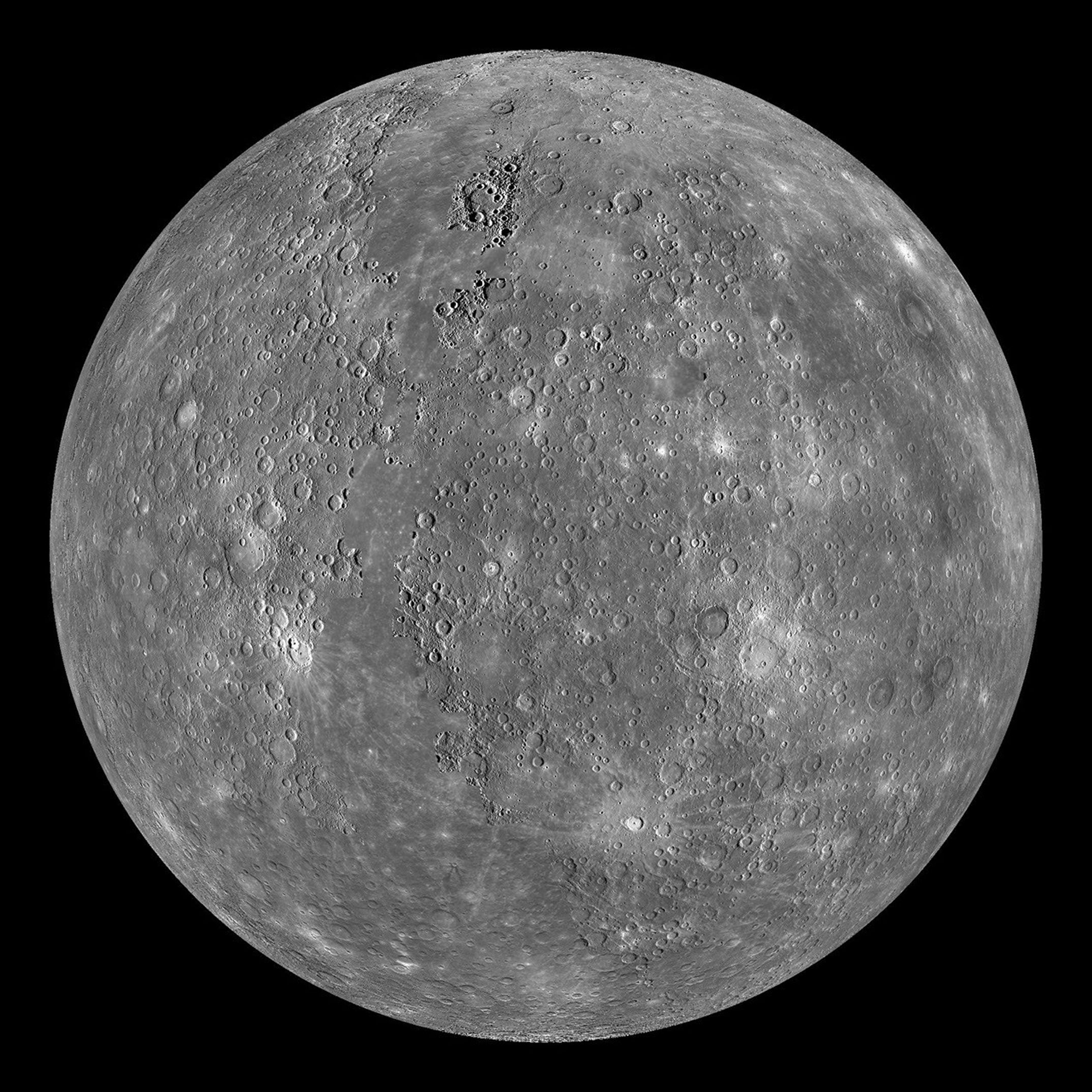
Mercury
A small, cratered world with an oversized core and an unusual day.
Quick facts
Object type: Terrestrial planet
Average distance from Sun: 0.387 AU; 57,900,000 km; 35,977,392 miles
Distance note: Average orbital distance (semimajor axis), not the planet’s changing distance from Earth.
Diameter: 4,879 km; 3,032 miles
Diameter note: Equatorial diameter; approximate and rounded.
Known moons: 0
Moon count last verified: 2026-10-03
About this count: Known natural satellites; counts change when discoveries are confirmed.
Year: 88 Earth days
Rotation: 58.65 Earth days
Solar day: 176 Earth days
Surface gravity: 3.7 m/s²
Gravity note: Approximate equatorial surface acceleration including rotation; values are rounded.
Temperature: Sunlit surface up to about 430 °C (800 °F); night side down to about −180 °C (−290 °F).
Atmosphere / composition: Rock and a large metal core; an extremely thin exosphere.
Rings: No known rings.
Remember this
One sunrise-to-sunrise day lasts two Mercury years.
Explore this world
Mercury races around the Sun while rotating slowly. Its 3:2 spin-orbit resonance means it turns three times during two orbits. This produces a solar day much longer than one rotation.
What makes it distinctive
Impact basins and long cliffs record collisions and the contraction of its cooling interior. Permanently shadowed polar craters can preserve ice.
Exploration
Mariner 10 made the first close visits. MESSENGER later mapped Mercury from orbit.
Mission updates
ESA/JAXA’s BepiColombo is the next major Mercury exploration mission. Follow the mission source for schedule updates.
Mission information last verified: 2026-10-03
Image credit
NASA/Johns Hopkins University Applied Physics Laboratory/Carnegie Institution of Washington
View the original image and its context
Sources and further reading
NASA science and mission reference
NASA science and mission reference
Science last verified: 2026-10-03
This permanent Solar System guide accompanies reusable AstroTours Planet Walk flags. Discovery continues, so online information can change while your flag's QR address stays the same.