
.png)
Mars
A rusty desert world with evidence of a wetter past.
Quick facts
Object type: Terrestrial planet
Average distance from Sun: 1.524 AU; 228,000,000 km; 141,672,632 miles
Distance note: Average orbital distance (semimajor axis), not the planet’s changing distance from Earth.
Diameter: 6,792 km; 4,220 miles
Diameter note: Equatorial diameter; approximate and rounded.
Known moons: 2
Moon count last verified: 2026-10-03
About this count: Known natural satellites; counts change when discoveries are confirmed.
Year: 687 Earth days
Rotation: About 24.6 hours
Solar day: About 24 hours 39 minutes
Surface gravity: 3.7 m/s²
Gravity note: Approximate equatorial surface acceleration including rotation; values are rounded.
Temperature: Average surface temperature about −65 °C (−85 °F), with strong variation.
Atmosphere / composition: Rocky planet with a thin, mostly carbon-dioxide atmosphere.
Rings: No known rings.
Remember this
Mars’s red color comes from oxidized iron in its soil.
Explore this world
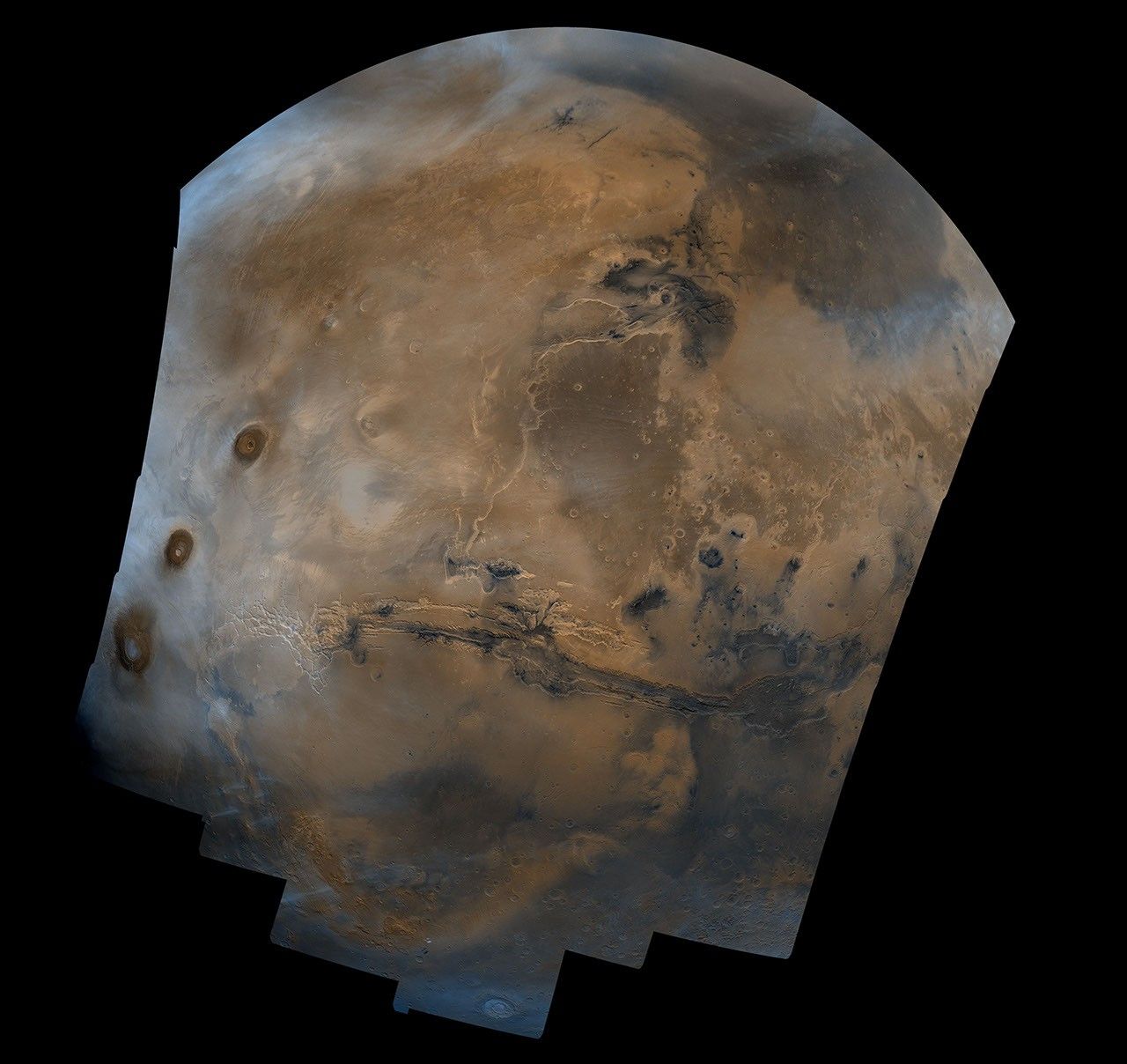
Mars has seasons, polar caps, weather and immense volcanic landscapes. Spacecraft have found evidence that water shaped its surface long ago. Studying those ancient environments helps scientists investigate whether Mars once supported life.
What makes it distinctive
The Valles Marineris canyon system spans a large part of the planet. Its small moons are Phobos and Deimos.
Exploration
Orbiters, landers and rovers have explored Mars at scales ranging from the whole globe to individual rocks.
Mission updates
Curiosity investigates ancient habitable environments; Perseverance studies Jezero Crater and collects samples. Their mission pages carry current updates.
Mission information last verified: 2026-10-03
Image credit
NASA/JPL/USGS
View the original image and its context
Sources and further reading
NASA science and mission reference
NASA science and mission reference
NASA science and mission reference
Science last verified: 2026-10-03
This permanent Solar System guide accompanies reusable AstroTours Planet Walk flags. Discovery continues, so online information can change while your flag's QR address stays the same.