
.png)
Jupiter
The largest planet, with fast-moving clouds and a diverse family of moons.
Quick facts
Object type: Gas giant
Average distance from Sun: 5.204 AU; 778,500,000 km; 483,737,473 miles
Distance note: Average orbital distance (semimajor axis), not the planet’s changing distance from Earth.
Diameter: 142,976 km; 88,841 miles
Diameter note: Approximate equatorial diameter at the 1-bar level, using the 2026 Juno result (about 8 km narrower than the older 142,984 km value).
Known moons: 115
Moon count last verified: 2026-10-03
About this count: Known natural satellites; counts change when discoveries are confirmed.
Year: About 11.9 Earth years
Rotation: About 9.9 hours
Solar day: About 9.9 hours
Gravity note: No solid surface. Gravity depends on atmospheric level; surface gravity is omitted.
Temperature: About −110 °C (−166 °F) at the 1-bar atmospheric level; much hotter deeper inside.
Atmosphere / composition: Mostly hydrogen and helium, with cloud layers and a deep, high-pressure interior.
Rings: A faint system of dust rings.
Remember this
Jupiter completes a rotation in less than ten hours.
Explore this world
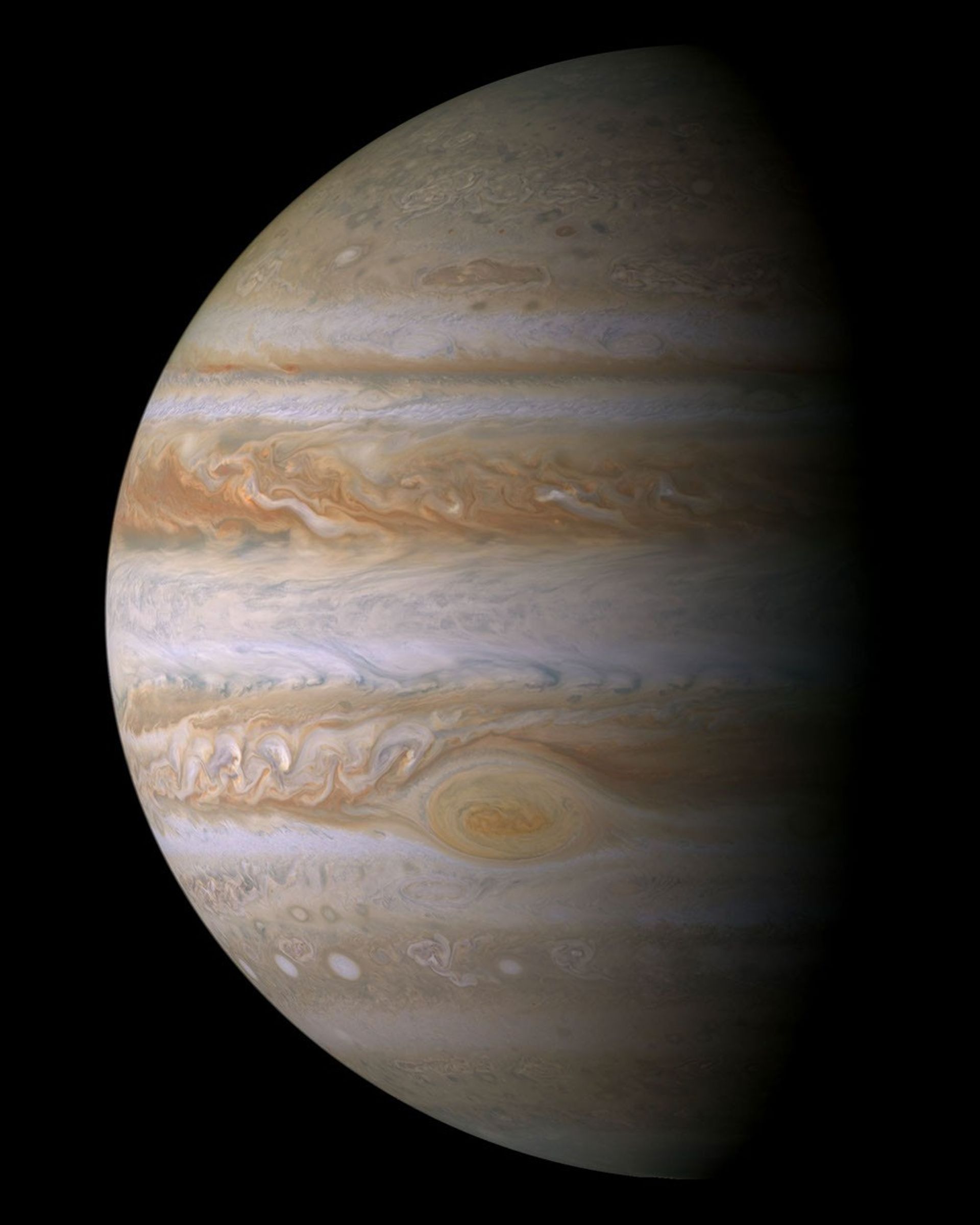
Jupiter’s visible bands trace atmospheric motion above an immense interior. The Great Red Spot is a persistent storm. Its four large Galilean moons make the system a varied collection of worlds, including icy Europa and volcanic Io.
What makes it distinctive
Juno measurements improved the size estimate in 2026. Even basic measurements of familiar worlds change as evidence improves.
Exploration
Voyager revealed Jupiter’s faint rings. Galileo and Juno extended our study of its atmosphere, interior and moons.
Mission updates
Europa Clipper is traveling to Jupiter to investigate Europa’s potential habitability, with arrival planned for 2030. Follow its mission page for current updates.
Mission information last verified: 2026-10-03
Image credit
NASA/JPL/Space Science Institute
View the original image and its context
Sources and further reading
NASA science and mission reference
JPL recognized satellite census
NASA science and mission reference
NASA science and mission reference
NASA science and mission reference
Science last verified: 2026-10-03
This permanent Solar System guide accompanies reusable AstroTours Planet Walk flags. Discovery continues, so online information can change while your flag's QR address stays the same.