
.png)
Asteroid Belt
A widely spaced population of small worlds between Mars and Jupiter.
Quick facts
Object type: Region of small Solar System bodies
Distance note: Main-belt region approximately 2.2–3.2 AU from the Sun (about 329–479 million km; 204–297 million miles). There is no single average for the whole belt.
Diameter note: Not applicable: a region containing many separate objects.
Moons: Not applicable to the belt as a whole. Some individual asteroids have moons.
Year: Varies by object and orbit.
Rotation: Varies by object.
Solar day: Varies by object.
Gravity note: Varies by object; the belt has no shared surface.
Temperature: Varies with each object’s distance, illumination and surface.
Atmosphere / composition: Diverse rocky and metallic bodies, including carbon-rich and silicate-rich asteroids.
Rings: The belt is a population of objects orbiting the Sun.
Remember this
All the asteroids combined have less mass than Earth’s Moon.
Explore this world
The main belt preserves remnants of early planet formation. Its objects are widely separated, giving spacecraft plenty of room to travel between them. Ceres, a dwarf planet, and Vesta are two of its most massive residents.
What makes it distinctive
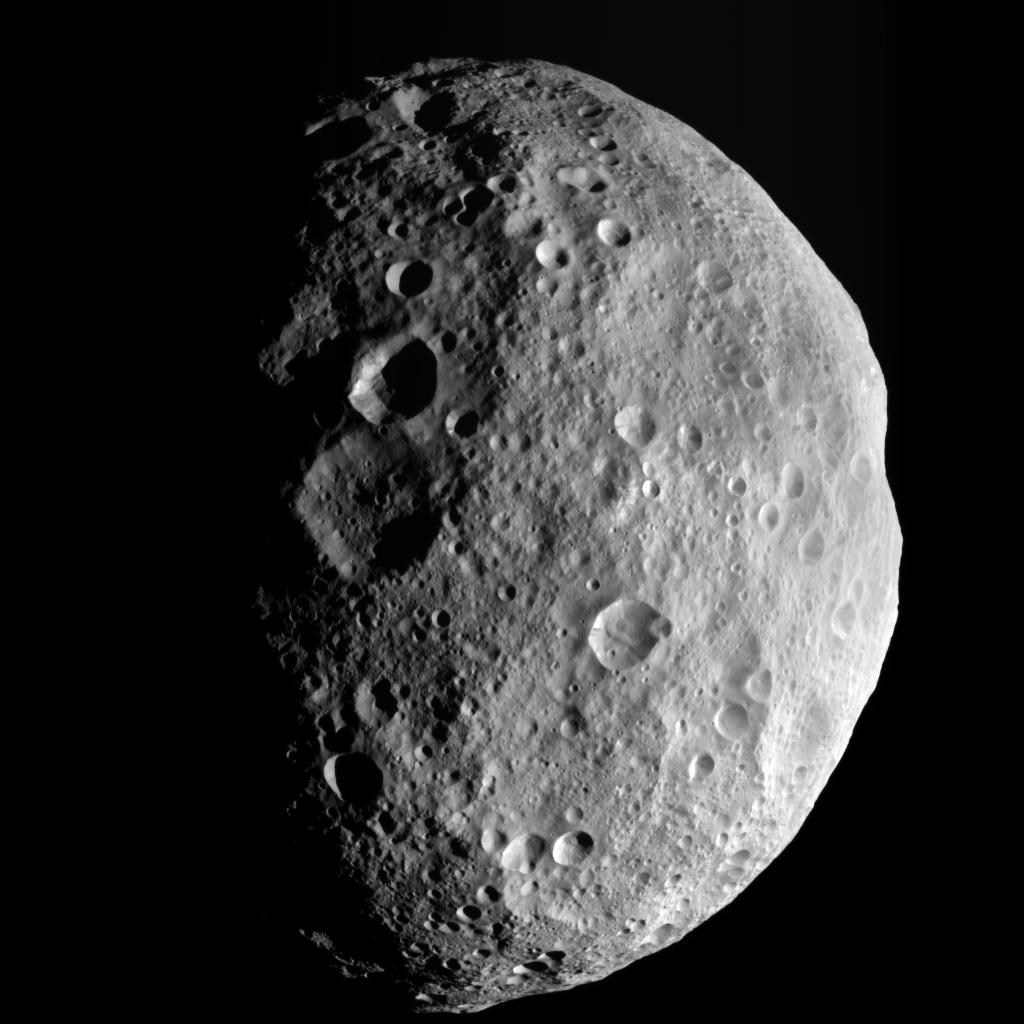
Each body has its own orbit, size and geology. The photograph shows Vesta, one member of the belt, rather than a view of the entire region.
Exploration
NASA’s Dawn mission orbited Vesta and Ceres, revealing very different histories.
Mission updates
Dawn’s archived observations remain a resource for studying these early worlds.
Mission information last verified: 2026-10-03
Image credit
NASA/JPL-Caltech/UCLA/MPS/DLR/IDA
View the original image and its context
Sources and further reading
NASA science and mission reference
NASA science and mission reference
Dawn image of Vesta and full credit
Science last verified: 2026-10-03
This permanent Solar System guide accompanies reusable AstroTours Planet Walk flags. Discovery continues, so online information can change while your flag's QR address stays the same.